

Table of Contents
Heat Recovery Ventilation Systems – Design, Supply & Installation in Ireland
A well-designed heat recovery ventilation system (MVHR system) keeps fresh, filtered air moving through your home while retaining valuable warmth that would normally escape. As a result, homeowners reduce heating demand, control condensation, and maintain continuous airflow in line with Irish Building Regulations.
What Is Heat Recovery System
Balanced Airflow and Measured Performance
Heat Recovery and Energy Efficiency Metrics
Comfort, Indoor Air Quality and Moisture Control
Our MVHR system Installation and Commissioning Process
Installing and commissioning an MVHR system in Ireland requires careful design, precise installation, and certified validation. At Eco Vent, we manage the entire process — from concept to handover — ensuring full compliance with TGD Part F (2019) and Part L (2022).
1) System Design (Regulation-Compliant)
We design each MVHR system strictly in accordance with TGD Part F 2019, which requires airflow rates to be calculated based on:
– Occupancy load determined by number of bedrooms, and
– Minimum extract and whole-house continuous ventilation rates as set out in Section 1.2.2 and 1.2.3 of TGD F .Design also incorporates:
– Airtightness assumptions: Part L requires reasonable care to limit air permeability and encourages low air permeability for energy efficiency (typically ≤3 m³/(h·m²) @ 50 Pa for MVHR suitability) .
– Duct sizing and pressure loss Calculations to ensure fans can achieve design flows without exceeding SFP backstops under Part L.
– Thermal bridging and insulation continuity considerations per TGD L and SR54 to avoid condensation and ensure MVHR energy performance is not undermined .
– Noise limits, installation accessibility, and fire safety requirements for ducts near protected stairways (TGD B) .All designs produce:
1. Room-by-room supply and extract rates (L/s)
2. Duct routes and diameters based on frictional/ dynamic losses
3. Unit selection sized for duty at Irish winter design conditions
4. Required homeowner information per TGD F Section 1.2.1.11Ductwork & Unit Installation
Installation is carried out in line with:
1. Part F Installation & Commissioning Guide (Section 3 – MVHR)
2. NSAI Validation Scheme requirements for proper workmanship and installation checks .Key requirements:
– Use rigid ductwork wherever possible; flexible ducting only where unavoidable and kept short (as per Installation Guide).
– Ducts must be supported, with minimal bends and smooth internal surfaces to reduce resistance, noise, and fan energy use.
– All joints sealed airtight to prevent leakage of moist extract air into roof spaces (Part F intent to prevent condensation issues).MVHR unit installed with:
– Safe access for filter replacement
– Vibration isolation
– Correct condensate management
– Ensure 10 mm undercuts below internal doors for airflow transfer, as required by Part F Clause 1.2.1.2 .Airflow Balancing & Commissioning
Commissioning follows:
1. Part F installation guide (Section 3)
2. IS EN 14134:2019 testing requirements (mandatory under NSAI Scheme) .Steps include:
– Measure all supply and extract terminals using calibrated instruments.
– The NSAI scheme specifies permitted measurement methods (unconditional, conditional, or benchmark) and calibration requirements.
– Adjust terminals so each room’s measured airflow matches the design level from TGD F tables.Verify:
– Correct direction of flow
– System controls
– Fan speeds
– Heat recovery unit performanceThe system must meet:
– Minimum continuous extract ventilation rates (wet rooms)
– Minimum whole-house ventilation rates (habitable rooms)
– Balanced supply vs extract (typical tolerance ±10–15%)Certification & Handover
Once installation and commissioning are verified, we prepare full documentation for Building Control and NSAI ventilation validation:
Delivered to client and builder:
– Room-by-room airflow verification report (required under TGD F).
– MVHR commissioning sheet, including:
– Specific Fan Power (SFP)
– Heat recovery efficiency
– Unit settings
– Maintenance access routes
– Homeowner operating and maintenance information, required under TGD F 1.2.1.11 (filter maintenance, controls, servicing intervals) .
Supply:
- Full MVHR system (centralised)
- Commissioning sheets & documentation (Part F compliant)
Tools:
- Bosch D-Tect 200
- Bosch laser distance measurer (with slope meter)
- Endoscope camera
- Drill + holesaw set
- Dust extractor with attachments
- DeWalt multitool
- Core drill (diamond)
- Ladder
- Multimeter
- Tape measure
- Screwdrivers & bits
- Tin snips
- Angle grinder
- Silicone gun
- PPE: mask, gloves, goggles
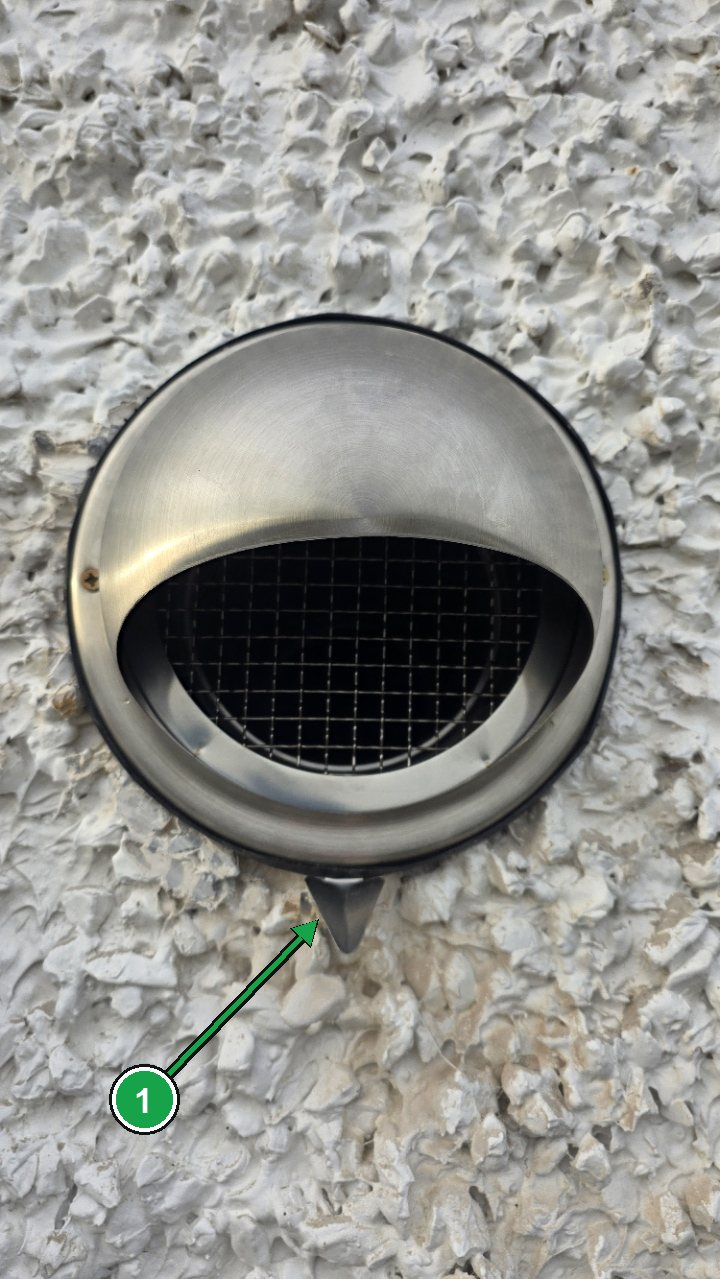
Materials: Ductwork – rigid or semi-rigid (PE-HD / PVC / metal) Duct insulation Air valves (extrac & supplyt) Room terminals / grilles External wall/roof terminals (weatherproof cowls or hoods) Controllers / boost switches / humidity or CO₂ sensors Fire-rated duct components Mounting brackets & anti-vibration mounts All duct seals & gaskets (EPDM / rubber) Manifolds Attic walk-board / 1.5 m² platform if needed Fixings: screws, strap banding, anchors, supports Electrical connection materials (isolation switch, cable)
Altogether, this documentation proves that adequate ventilation has been delivered — not just installed — ensuring your system performs exactly as designed.


Why Choose Eco Vent
Costs & Grants
A whole-house heat recovery ventilation system, supplied, installed and commissioned, starts at €6,200 incl. VAT for homes up to about 100 m². Most homes of 115–250 m² come to about €6,400–€7,400, and homes over 250 m² start at €8,400. Get the price for your floor area. New to MVHR? Read how a heat recovery ventilation system works and how it compares with other home ventilation systems.
Notice Title
Although Eco Vent is not an SEAI-registered contractor, we still design every mechanical ventilation system to fully meet SEAI performance standards. Moreover, we actively support grant applications by providing all required commissioning documentation for third-party validation and retrofit submissions. As a result, homeowners and builders can confidently demonstrate compliance and energy performance during SEAI or Building Control assessments.
Frequently Asked Questions — MVHR Installation
How long does installation take?
A standard MVHR installation typically takes one working week, provided that duct routes are prepared and accessible.
Is commissioning required?
Yes.
A signed balancing and validation report is mandatory for Building Control and energy verification.
You can download the official Part F commissioning sheet (PDF) from our handover pack:
https://ecovent.ie/wp-content/uploads/2025/10/Part_F_2019_Installation_and_Commissioning_Guide.pdf.pdf
How often should I service the system?
Filters should be checked regularly in line with the manufacturer’s instructions and replaced at least once per year.
A full service every 1–3 years is recommended for most domestic properties to maintain optimal airflow, hygiene, and efficiency.
What are common problems with MVHR and how can they be fixed?
Typical issues include unbalanced airflow, clogged filters, and incomplete commissioning. These faults can lead to noise, reduced ventilation rates, or poor indoor air quality.
To correct these issues, the system should be professionally balanced, filters replaced on schedule, and the heat exchanger cleaned periodically.
Routine performance testing also helps ensure that the installation continues to meet the requirements of TGD Part F (2019) and Part L (2022).
How does MVHR improve indoor air quality and energy efficiency?
MVHR removes stale, humid air while supplying filtered fresh air throughout the home.
At the same time, the system recovers heat from the outgoing air, reducing energy loss.
This improves indoor air quality, lowers ventilation-related heat demand, and supports better compliance with modern energy standards.
Is third-party validation necessary for domestic MVHR systems?
Yes.
Third-party validation and certified performance testing are mandatory for regulatory compliance under Building Control 2025.
Can an MVHR system help prevent condensation and mould?
Yes.
By maintaining steady airflow and regulating humidity, MVHR significantly reduces the risk of condensation and mould.
This protects building materials, finishes, and overall indoor air quality—an essential requirement in airtight homes designed to meet TGD Part L (2022).
What maintenance does an MVHR system require?
Essential maintenance includes:
- regular filter replacement
- heat exchanger cleaning
- cleaning of plenums and air valves
- checking the condensate drain
- ductwork inspection
- airflow checks when required
Annual professional servicing is strongly recommended to maintain optimal performance, extend system lifespan, and remain compliant with TGD Part F (2019) and NSAI validation requirements (2025).
How often should MVHR filters be replaced?
Filters should be cleaned or replaced every 6–12 months, depending on usage and local air quality.
Vacuuming the filters every three months helps remove surface dust and extend their life.
Routine filter maintenance ensures steady airflow, good indoor air quality, and continued compliance with TGD Part F (2019) and NSAI standards (2025).
Why install an MVHR system in my home or business?
MVHR improves indoor air quality, prevents moisture-related issues such as damp and mould, and supports high energy efficiency.
It is an essential component of modern, airtight, low-energy buildings in both residential and commercial settings.
Get Compliant, Comfortable Ventilation Today
Breathe cleaner air with MVHR System from Eco Vent.
Next steps for MVHR
Building it yourself?
Our DIY kits: designed from your plans, a Vent-Axia or DUCO unit, the Installation App, help while you fit it and our commissioning visit. MVHR kits ≈ €3,800–7,000, cMEV / DCV kits ≈ €1,550–3,500, incl. VAT.
External Authoritative Sources
- TGD Part F (2019) – Ventilation
- TGD Part L (2022) – Energy Performance
- Building Control (Amendment) Regulations 2025
Regulatory Context (2025 Updates)
Key Ventilation Updates — TGD F 2019 vs Proposed 2025
Ireland’s ventilation rules are governed by Technical Guidance Document F (TGD F). The 2025 draft revision introduces tighter performance, testing, and health standards compared to TGD F 2019.
Main Ventilation-Related Changes
- Airtightness
- Current: Max 7 m³/h/m² @ 50 Pa; MVHR homes recommended ≤3 m³/h/m².
- Proposed: Stricter limit of 5 m³/h/m² and mandatory airtightness verification.
- Commissioning & Validation
- Current: Installer commissions; third-party NSAI validator issues certificate.
- Proposed: Stricter validation per room, enhanced commissioning records, and detailed handover documentation.
- System Design & Installation
- Current: Designed by competent person; follows prescriptive flow rates.
- Proposed: Performance-based verification using EN 14134:2019; higher competency standards for designers/installers.
- Indoor Air Quality (IAQ)
- Current: Focus on moisture and pollutant control.
- Proposed: Links with EPBD Recast, CO₂ monitoring in key spaces, and emphasis on occupant health and outdoor air quality.
- Documentation & Handover
- Proposed 2025 requires a Home User Guide, airflow data per room, and clear operation/maintenance instructions.
- Natural Ventilation
- Proposed: Stronger checks for naturally ventilated dwellings, acknowledging performance gaps and integrating Part O (Overheating) strategies.
- Retrofit & Renovation
- Proposed: Mandatory ventilation impact checklist during renovations and linkage with energy upgrade (A3 BER) requirements.
- Energy Efficiency
- Proposed: Introduction of specific fan power (SFP) benchmarks and alignment with Part L (2025).
Overall Direction
The 2025 TGD F moves:
- From prescriptive to performance-based standards
- From design calculations to measured airflow results
- From energy focus to holistic indoor environmental quality
- From one-off validation to ongoing performance
- From passive to active ventilation for airtight homes
Until the new version is published, TGD F 2019 remains in force for ventilation compliance in Ireland.
References: Irish Statute Book — S.I. No.56/2025; gov.ie consultation; SEAI ventilation guidance.