
Table of Contents
Residential Mechanical Ventilation in Ireland – Practical Guide
Designing a ventilation system for a modern Irish home is no longer as simple as adding a few extract fans at the end of the project. Instead, residential mechanical ventilation design now directly influences indoor air quality, moisture control, energy performance and day-to-day comfort for occupants. Because new homes are more airtight, the ventilation strategy has become a core part of overall building design.
This practical guide gives architects, building designers and specialist installers a clear overview of mechanical ventilation system design for Irish dwellings. In particular, it explains how to choose the right system type, sketch realistic layouts, and check that the proposed design can be commissioned and validated on site in line with ventilation building regulations in Ireland, such as TGD Part F, TGD Part L and S.R. 54.
Why Healthy Residential Ventilation Design Matters in Modern Irish Homes
New-build and deep retrofit projects in Ireland are now highly insulated and relatively airtight. This is excellent for energy efficiency. However, it also means that:
- indoor pollutants and moisture can build up quickly when there is no reliable ventilation path
- cold surfaces for condensation are reduced, so moisture tends to migrate into the building fabric and hidden voids
- trickle vents and “leaky” construction no longer act as a safety net
Accordingly, a properly designed ventilation system for a home in Ireland should:
- provide consistent, clean fresh air to all habitable rooms
- extract moisture and odours at source from kitchens, bathrooms and utility rooms
- control airflows so that stale air does not move from wet rooms into bedrooms or living rooms
- operate quietly and efficiently, with intuitive controls for occupants
When you treat residential mechanical ventilation design as a core design discipline rather than an afterthought, it becomes much easier to deliver healthy, comfortable, energy-efficient homes that comply with Irish standards.
Step 1 – Choose the Right Ventilation Strategy from the 4 Types of Ventilation
The first design decision is which type of mechanical ventilation system to specify. In practice, most Irish dwellings use one of 4 types of ventilation strategies:
- MVHR – Mechanical Ventilation with Heat Recovery
- MEV – Centralised Mechanical Extract Ventilation
- DCV – Demand-Controlled Ventilation (usually MEV + sensors)
- PIV – Positive Input Ventilation (typically for specific retrofit scenarios)
For clarity, the sections below summarise how each option fits into residential mechanical ventilation design for Irish homes.
MVHR – Mechanical Ventilation with Heat Recovery
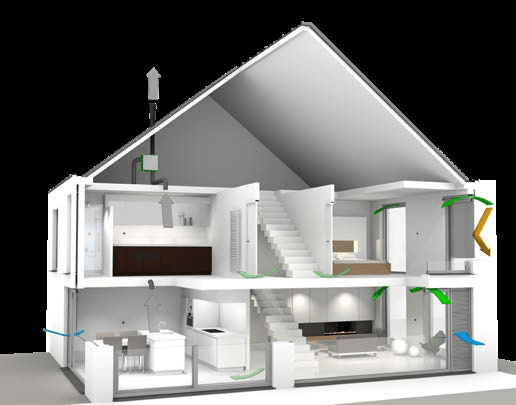
MVHR provides continuous supply and extract ventilation via a heat recovery unit. Fresh air is supplied to habitable rooms, while stale air is extracted from wet rooms and passed through a heat exchanger.
- Best suited to reasonably airtight dwellings, especially new builds.
- Provides controlled fresh air to all main rooms and recovers heat from extract air, reducing space heating demand.
- Requires careful ductwork coordination with structure and other services.
When mvhr system design is done well, it usually offers the best overall indoor air quality and comfort for Irish homes.
Use MVHR where:
- the building fabric and windows are good enough to justify heat recovery
- there is clear space for duct routes and a realistic plant location
- the client values energy performance and comfort, not just minimum compliance

MEV – Centralised Mechanical Extract Ventilation
Centralised mechanical extract ventilation (MEV) provides continuous extract from wet rooms, usually via a central fan and duct system. Fresh air is drawn in through background vents and any residual leakage.
- Simpler and cheaper than MVHR.
- No heat recovery and less control over supply air paths.
- Still an improvement over intermittent fans when designed correctly.
Use MEV where:
- airtightness is expected to be modest, or full MVHR is not practical
- duct routes for supply air are difficult but extract routes are achievable
- budget is tight but continuous mechanical extract is preferred over intermittent fans
DCV – Demand-Controlled Ventilation
Demand-controlled ventilation (DCV) is usually MEV with advanced control: the extract unit (or individual extract valves) automatically varies airflow based on sensor inputs such as humidity (RH), CO₂, or occupancy.
Put simply, any MEV system that changes airflow in response to a sensor is operating as demand control. The base system is still continuous mechanical extract, but the control strategy adjusts the duty point instead of relying only on fixed speeds and manual boost switches. DCV can also appear in hybrid arrangements, but in domestic dwellings it is most commonly implemented as sensor-controlled MEV.
Consider DCV where:
- occupancy patterns are unpredictable (for example, rental properties, home offices, occasional guest rooms)
- the client wants automatic boost and does not want to rely on manual switches
- moisture loads vary significantly through the day (showers, cooking, drying clothes indoors)
Because DCV responds to real conditions, it can maintain good indoor air quality while avoiding unnecessary high extract rates, which may reduce fan energy and improve comfort—provided the sensor strategy is specified correctly and commissioned properly.
PIV – Positive Input Ventilation (Typically for Retrofit)
The fourth of the 4 types of ventilation commonly mentioned in the Irish and UK markets is positive input ventilation (PIV). A PIV unit usually sits in a loft or central location and gently introduces filtered air into the dwelling, often via a single central supply grille.
- Fresh, slightly pressurised air is pushed into the property.
- Existing leakage paths and background vents are used as exhaust routes.
- PIV can be effective at reducing surface condensation and mould risk in older, leaky homes.
However, it is important to understand how PIV fits into residential mechanical ventilation design:
- PIV is generally best viewed as a condensation-control or air-improvement measure for existing dwellings, not a full mechanical ventilation system for highly airtight new builds.
- It normally does not provide dedicated extract from wet rooms, so it may not, on its own, satisfy all aspects of Irish ventilation building regulations Ireland for new dwellings.
- In many retrofit projects, PIV is considered only where other conventional ducted systems are impractical and where the dwelling remains relatively permeable.
Consequently, PIV can be a useful tool in specific retrofit scenarios, but MVHR, MEV or DCV-based systems are usually preferred as the primary strategies for new or very airtight homes.
For each project, it is wise to record why you selected MVHR, MEV, DCV or PIV. Because this rationale is documented, later discussions with the Assigned Certifier, BER assessor and client usually become more straightforward.
Step 2 – Determine Design Airflows for Each Room
Once the system type is selected, the next step in residential mechanical ventilation design is to calculate room-by-room supply and extract rates.
In practice, you should:
- Calculate or obtain the minimum whole-house ventilation rate based on dwelling floor area and number of bedrooms, using the relevant Irish guidance and ventilation building regulations Ireland (for example, TGD Part F and S.R. 54).
- Allocate this whole-house rate to individual rooms:
- Extract from: kitchen, utility, bathrooms, WC, ensuite and similar wet rooms.
- Supply to: living rooms, bedrooms, study and other habitable spaces.
Additionally, you should consider higher extract rates for:
- internal rooms with no windows
- heavily used kitchens or utility rooms
- rooms with clothes drying or consistently high moisture loads
At this stage, it is critical to check that your chosen MVHR or MEV unit can deliver the total design flow with spare capacity at acceptable external static pressure (ESP). If the fan curve shows you are already on the limit, it is better to adjust the design now than to rely on “heroic” commissioning later.
Step 3 – Sketch Practical Duct Routes Early in the Design
For MVHR and centralised MEV, duct routes often determine whether the mechanical ventilation system design will actually work on site. Therefore, architects and designers can avoid many issues by sketching practical routes early, alongside structure, plumbing and electrical layouts.
Key points include:
- Keep ducts as short and straight as possible. Every bend, branch and reduction adds resistance and potential noise.
- Reserve ceiling zones or service voids for main runs before the structural design is finalised.
- Avoid crossing main beams and trusses with large ducts unless there is no alternative.
- Plan vertical risers and drops for apartments, three-storey dwellings or rooms off half-landings.
- Think ahead about maintenance access to the MVHR unit, filters and key duct joints.
A useful rule of thumb is: if you cannot draw a clean duct route to a valve on your plan without zig-zagging around obstacles, the installer will struggle even more once the building is on site.
Step 4 – Size Ducts and Grilles Correctly
Duct sizing is fundamental to both performance and noise control in residential systems. For each branch, you should:
- Sum the design flow rates served by that branch.
- Choose a duct size that keeps air velocities within a sensible range for homes (typically 1.5–3 m/s in main ducts, lower in branches to bedrooms).
- Check that the selected size is compatible with available fittings, silencers and manifold units.
Radial or Semi-Rigid Systems
For radial or semi-rigid layouts, you should:
- Use manufacturer guidance to match per-branch flow rates with duct diameter and maximum run length.
- Avoid mixing too many different duct types in one system unless there is a clear, documented reason.
Rigid Round or Rectangular Systems
For rigid systems, it is generally better to:
- Use smooth, rigid ducts for longer main runs.
- Limit flexible duct to short connections at valves and keep it fully stretched to avoid crushing and additional resistance.
At valve level, select grille sizes that will not create excessive noise or draughts at the design flow rate. This is especially important in bedrooms, where low background noise is a key comfort requirement.
Step 5 – Coordinate MVHR Plant and External Penetrations
MVHR requires more than a spare corner in a hot press. To keep the system reliable and easy to service, you should:
- Allow sufficient space around the unit for filter changes, maintenance and potential future replacement.
- Plan intake and exhaust terminals so that:
- they are clearly separated from each other
- they are kept away from flues, chimneys and other odour or pollution sources
- they remain accessible for cleaning and future replacement
In apartments, terraces and dense urban sites, you should also consider the appearance of façades and any planning conditions covering external grilles or louvres. Because these penetrations are visible, early coordination with the architect usually prevents late design changes.
Step 6 – Plan for Proven Commissioning, Validation and Documentation
Good residential mechanical ventilation design makes commissioning and, where applicable, independent validation straightforward. Therefore, when sketching your layout, ask:
- Can each valve be accessed safely and easily to measure airflow?
- Are there sensible locations for system balancing devices, silencers and manifold boxes?
- Is there a clear route for condensate drainage from the MVHR unit?
- Are there realistic cable routes for boost switches and any humidity or CO₂ sensors?
Your design package should normally include:
- a ventilation schedule listing design supply and extract rates for each room
- a schematic or layout drawing showing ducts, valves, manifolds and plant
- notes requiring a commissioning report with measured flow rates and final fan settings at handover
These items make it easier for the installer to deliver the system you intended, and they support sign-off against ventilation building regulations Ireland, as well as any NSAI-aligned validation requirements.
For projects where you are not providing the full service, you can link to a dedicated ventilation validation and commissioning service page (for example, /ventilation-validation-commissioning) so clients understand how testing and paperwork are handled.
What to Show on Drawings for Architects and CAD Technicians
For typical Irish dwellings, a clear drawing set helps everyone—from designers and installers to inspectors. A practical approach is:
General Arrangement (GA) Plans
- Show MVHR or MEV unit location.
- Indicate main duct routes.
- Mark supply and extract valve positions with simple, consistent symbols.
Services or Reflected Ceiling Plans
- Show detailed duct routing, duct sizes, manifolds and silencers.
- Highlight coordination zones where ventilation must share space with heating, plumbing or electrical services.
Sections and Details
- Include key details where ducts pass through structure, fire separations or acoustic linings.
- Show typical dropped ceiling or service void build-ups and any acoustic treatment in bedroom zones.
Because these drawings are clear and consistent, they significantly reduce queries during installation and later validation.
When to Consider a Specialist Residential Ventilation Design Service
On straightforward dwellings, experienced architects and M&E designers may feel comfortable producing the entire mechanical ventilation system design themselves. However, it is often wise to involve a specialist when:
- the dwelling is unusually large, complex or highly glazed
- airtightness targets are ambitious and the client expects very high comfort levels
- there are significant acoustic constraints (for example, urban locations or very noise-sensitive bedrooms)
- the project team wants a single point of responsibility for mvhr system design, supply and commissioning
A specialist residential ventilation designer can:
- produce a detailed design pack including layouts, schedules and pressure-loss calculations
- advise on product selection tailored to Irish climate and building types
- support installers during commissioning and troubleshooting
- coordinate with validation and compliance requirements so that handover is smoother
Summary – Designing Reliable Residential Ventilation that Works in the Real World
A successful residential mechanical ventilation design for an Irish home is not just a set of lines on a drawing. Instead, it is a complete system that:
- meets Irish ventilation building regulations and energy requirements
- can be installed without major compromises on site
- can be commissioned and, where necessary, validated to deliver the design airflows
- is simple for the homeowner to understand, operate and maintain
By bringing ventilation into early design conversations, reserving space for ducts and plant, and insisting on clear commissioning documentation at handover, architects and designers can avoid the persistent IAQ and moisture issues still seen in some new Irish homes.
When you understand the 4 types of ventilation available—MVHR, MEV, DCV and PIV—you can select the right strategy for each project instead of relying on a one-size-fits-all solution. If you prefer to outsource some or all of your residential mechanical ventilation design, EcoVent can help.